How does radiation damage cancer cells?
Radiation deposits energy in cells and damages their DNA. Some damage happens directly and some through chemical changes within the cell. If a cancer cell cannot repair enough of that damage, it stops dividing or dies.
Normal cells can also be affected. Careful targeting limits the amount of normal tissue treated, and many normal cells repair radiation damage more effectively than cancer cells. The balance between tumour effect and normal-tissue recovery shapes the dose and schedule.
The effect is not always immediate. Cancer cells may die over days or weeks after radiation, and a scan performed soon after treatment may show inflammation as well as treatment response.
What is external-beam radiotherapy?
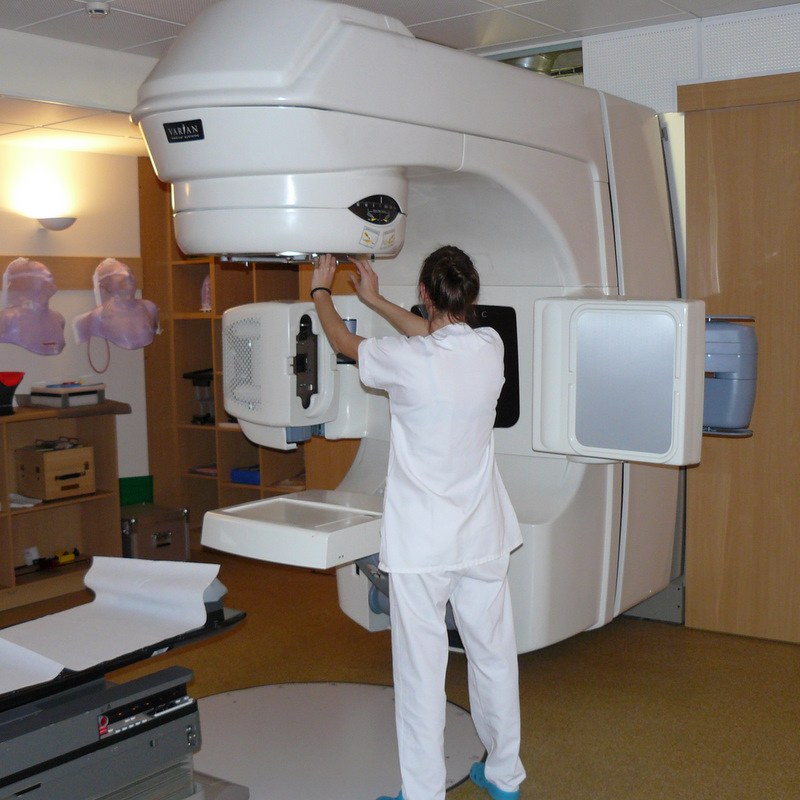
Most radiotherapy is external-beam radiotherapy. A machine called a linear accelerator directs radiation at a defined area of the body. The machine may move around you, but it does not touch you, and the treatment itself is usually painless.
Other forms include radioactive material placed inside or near a tumour, known as brachytherapy, and radioactive medicines that travel through the body. The rest of this article mainly concerns external-beam treatment.
Why is treatment carefully planned?
The aim is to deliver the prescribed dose to the intended target while keeping the dose to nearby organs within appropriate limits.
Most people have a planning CT in the position that will be used for treatment. The team outlines the target and organs at risk, combines other scans where useful, and calculates how the radiation beams can achieve the required dose distribution.
This work takes place before the first fraction and undergoes clinical and technical checks. What happens before radiotherapy starts? explains the preparation in more detail.

What are radiotherapy fractions?
Each treatment visit is commonly called a fraction. A course may involve one fraction or many fractions over several days or weeks.
Dividing the total dose can allow normal tissue time to repair between treatments. Different cancers and normal tissues respond differently to dose per fraction, so the number of visits is part of the treatment design.
A longer course is not automatically stronger or better. A short course is not automatically less effective. SABR, for example, gives a high dose per fraction in a small number of precisely delivered treatments for selected targets.
How does image guidance improve precision?
Positioning a patient in the same way each day is not enough on its own. Internal anatomy can move or change. Image-guided radiotherapy uses imaging on the treatment machine to compare the treatment-day anatomy with the plan.
The team may correct the patient's position, check a target or nearby organ, or decide that a larger change needs clinical review. Some systems can track motion or adapt a plan. MR-guided radiotherapy uses MRI to visualise selected soft-tissue targets and can support online adaptation in appropriate cases.
What if a tumour moves?
Tumours in the chest and upper abdomen may move with breathing. The stomach, bowel and bladder can also change position or shape.
Teams may use 4D CT, breath-hold, gating, tracking, treatment margins and imaging during delivery. The right method depends on the target and equipment. The focused article on how radiotherapy targets moving tumours explains these approaches.
Why does radiotherapy differ between patients?
Two people with the same broad cancer diagnosis may receive different radiotherapy because of:
- tumour size, site and stage;
- the treatment aim;
- previous surgery, drug treatment or radiotherapy;
- nearby sensitive organs;
- tumour movement and day-to-day anatomy;
- general health and ability to maintain the treatment position;
- evidence for the particular cancer.
Precision means matching the treatment to the clinical problem. It does not mean that the newest or most complex machine is automatically best.
Curative and palliative uses
Radiotherapy may be used with curative intent as the main treatment or before or after surgery. It can be combined with drug treatment or used to reduce recurrence risk in a particular area.
With palliative intent, radiotherapy may control a tumour or relieve pain, bleeding, pressure or another symptom. A palliative course can still be carefully planned and clinically important. The word describes the aim, not the quality of treatment.
Side effects depend on the treated area
Side effects usually relate to the tissues receiving radiation. Some develop during treatment, some in the following weeks, and a smaller number can occur months or years later.
Your team should explain the effects relevant to your plan rather than provide a list covering every part of the body. Report new symptoms during treatment so the cause and appropriate support can be assessed.
Questions to ask
- What is the aim of my radiotherapy?
- Which area will be treated?
- How many fractions are planned, and why?
- How will imaging and movement be managed?
- Which short-term and long-term side effects are most relevant?
- Who should I contact if I have problems?
Radiotherapy combines radiation biology, imaging, planning and accurate delivery. The technique is chosen to give the intended target an effective dose while protecting normal tissues as far as reasonably possible.